
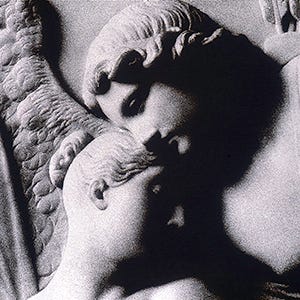
Jung believed it was important for individuals
to develop a personal myth about death.
This myth was not meant to be a literal story,
but rather a psychological framework
to help us grapple with the inevitability of death
and to find meaning in it.
Jung believed that death was an archetype,
a universal symbol that combines with our individual lives
to make them whole.
From his perspective,
death was not an end, but a goal,
and he understood life’s inclination toward death
to begin as soon as we passed life’s meridian.
In his autobiography, Memories, Dreams, Reflections, he advised:
A man should be able to say he has done his best
to form a conception of life after death,
or to create some image of it—
even if he must confess his failure.
Not to have done so is a vital loss.
For the question that is posed to him
is the age-old heritage of humanity:
an archetype, rich in secret life,
which seeks to add itself to our own individual life
in order to make it whole….
The more the critical reason dominates,
the more impoverished life becomes;
but the more of the unconscious
and the more of myth we are capable of making conscious,
the more of life we integrate.
Joanna Ebenstein
Memento Mori
The Art of Contemplating Death to Live a Better Life